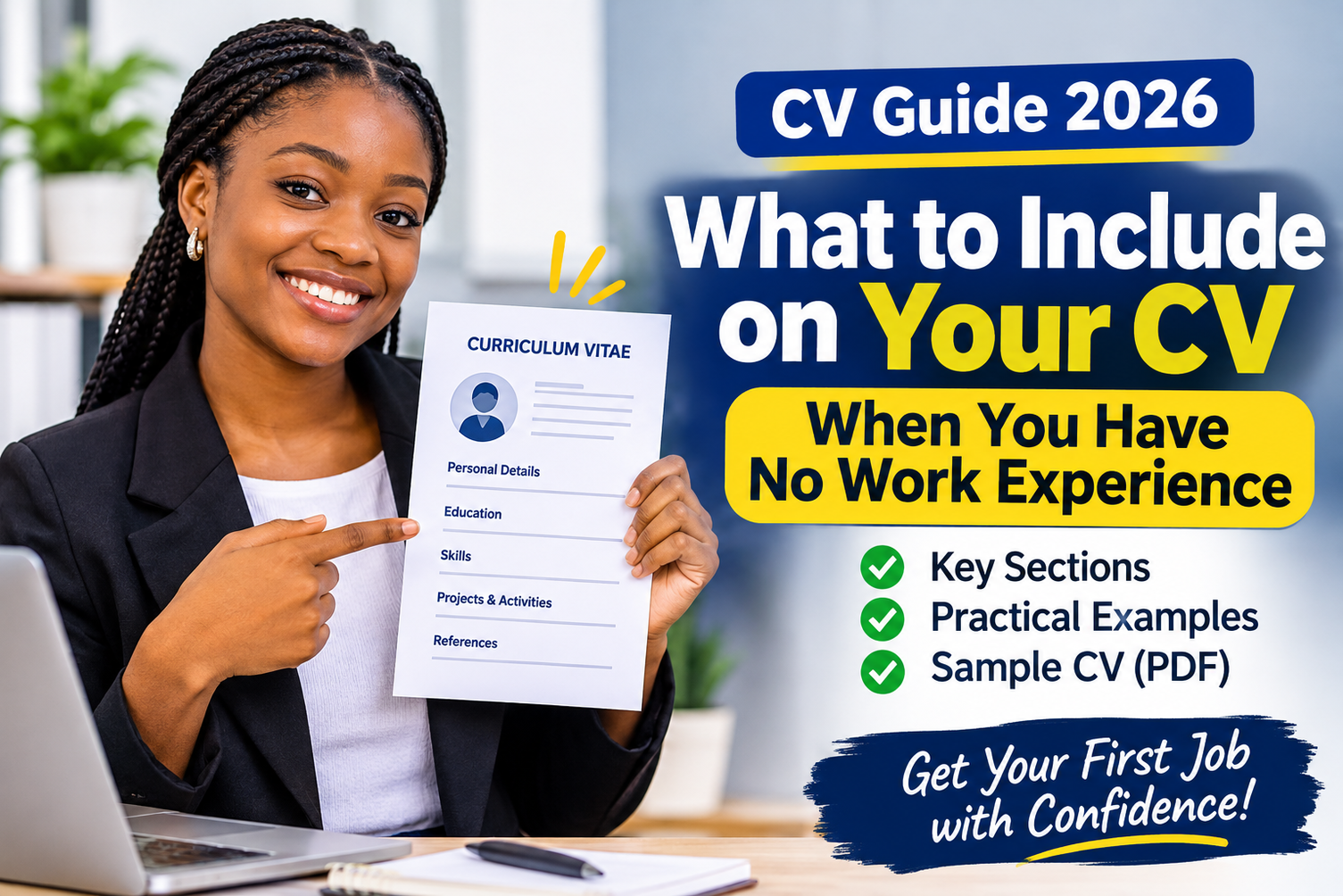
How to Create Professional CV 2026: Welcome to masterjob.com.ng, A dedicated Nigerian website actively helping young, graduates and job seekers to discover job opportunities, CV guides, Grants and verified government empowerments programmes.
Getting your first job can be challenging, especially when you have never worked in a company or organisation before.
One of the biggest problems fresh graduates and first-time job seekers face is knowing what to include on their CV. Many believe employers will reject them because they have no previous work experience.
However, you do not need formal work experience before you can prepare a good CV. You can still present your education, relevant skills, academic projects, industrial training, volunteering activities and other useful experiences in a professional way.
The important thing is to show employers what you can contribute, even if you have not held a paid job before.
Get Important Updates from MasterJob!
Follow our WhatsApp Channel for job vacancies, recruitment news, shortlist updates and education opportunities.
JOIN OUR WHATSAPP CHANNELIn this guide, you will learn what to put on your CV when you have never worked before, how to arrange each section, what to avoid and how to use a sample CV when preparing your first job application.
What Should I Put on My CV If I Have Never Worked Before?
If you have never worked before, your CV should focus on your educational background, skills, academic projects, training, volunteering activities and other experiences that demonstrate your ability to perform a job.
Here are the important sections to include:
- Personal information and contact details.
- Professional summary.
- Educational qualifications.
- Relevant skills.
- Academic projects.
- Industrial training or SIWES, if applicable.
- Volunteering and leadership experience.
- Training and certifications.
- Referees, when requested.
You do not have to include every section if it does not apply to you. The goal is to present genuine information that supports your application.
1. Start With Your Full Name and Contact Details
Your name and contact information should appear at the top of your CV.
An employer should be able to identify you and contact you without searching through the document.
Include:
- Full name.
- Active phone number.
- Professional email address.
- City and state of residence.
For example:
Name: Chinedu Michael Okafor
Phone: 080XXXXXXXX
Email: chineduokafor@email.com
Location: Benin City, Edo State.
Use an email address that looks professional. Avoid funny usernames or email addresses that may create a poor first impression.
You generally do not need to include your religion, marital status, full residential address or date of birth unless the employer specifically requests them.
2. Write a Professional Summary
A professional summary is a short introduction that tells an employer who you are, what you have studied and what relevant qualities you can bring to the organisation.
Since you have no formal work experience, do not pretend to have worked before. Instead, focus on your education, abilities and willingness to learn.
Example for a fresh graduate:
A motivated Business Administration graduate with good communication, organisation and problem-solving skills. Possesses knowledge of basic office administration, record keeping and customer service. Eager to begin a professional career, contribute to organisational goals and develop practical workplace experience.
Example for an applicant with SSCE:
A hardworking and responsible secondary school graduate with good communication skills and the ability to work effectively with others. Willing to learn, follow instructions and contribute positively to a team. Seeking an entry-level opportunity to develop practical skills and gain workplace experience.
Keep your summary short and relevant to the position you are applying for.
3. Include Your Educational Qualifications
Your educational background is particularly important when you have never worked before.
List your qualifications starting with the most recent.
Include:
- Name of institution.
- Qualification obtained or expected.
- Course of study, where applicable.
- Graduation year or expected completion year.
Example:
University of Benin
Bachelor of Science (B.Sc.) in Business Administration
2025
Government Secondary School, Benin City
West African Senior School Certificate Examination (WASSCE)
2020
If you are still studying, state that your programme is ongoing and include your expected graduation date if known.
Do not claim a qualification you have not obtained.
4. Add Skills Relevant to the Job
Skills help employers understand what you can do, even without previous employment.
However, avoid listing skills simply because they sound impressive. Include abilities you genuinely possess and can demonstrate if an employer asks you about them.
Examples include:
- Communication skills.
- Teamwork and collaboration.
- Time management.
- Problem-solving.
- Basic computer literacy.
- Microsoft Word and Excel.
- Customer service.
- Research and information gathering.
- Writing and documentation.
- Organisation and record keeping.
Important: Your skills should match the position you are applying for.
For example, someone applying for an administrative assistant position may highlight computer literacy, record keeping, organisation and communication skills.
Someone applying for a customer service role may focus more on communication, patience, problem-solving and interpersonal skills.
5. Include Academic Projects
Many fresh graduates overlook academic projects when preparing their CVs.
If you completed a research project, practical assignment, group presentation or final-year project, you can include it if it demonstrates skills relevant to the job.
For example:
Academic Project: Customer Satisfaction and Business Performance
- Conducted research on factors affecting customer satisfaction.
- Collected and organised information for academic analysis.
- Prepared a written report and presented findings.
- Worked with other students to complete project activities.
This section can help demonstrate research, communication, teamwork and analytical abilities.
Do not invent a project. Include only work you actually completed.
6. Include SIWES or Industrial Training
If you participated in the Students Industrial Work Experience Scheme (SIWES), industrial attachment or any form of practical training, include it on your CV.
Although it may not be a permanent paid job, it can demonstrate that you have had some exposure to a workplace.
You can include:
- Name of the organisation.
- Your training period.
- Department or area of placement.
- Duties performed.
- Skills gained.
Example:
Industrial Trainee – ABC Business Centre
June 2024 – November 2024
- Assisted with basic administrative duties.
- Organised and arranged office documents.
- Supported data entry and record keeping.
- Observed daily office operations.
If you have never participated in SIWES or industrial training, simply leave this section out.
7. Add Volunteering and Leadership Experience
Have you ever volunteered at an event, participated in a community project, served as a class representative or held a leadership position in a student organisation?
These activities may be relevant to your CV.
For example:
Volunteer – Community Sanitation Exercise
- Participated in community cleaning activities.
- Worked with other volunteers to organise assigned tasks.
- Supported awareness activities within the community.
Class Representative
- Communicated students’ concerns to lecturers.
- Assisted in sharing important academic information.
- Helped coordinate class activities.
These experiences can demonstrate responsibility, teamwork, communication and leadership.
Only include activities you genuinely participated in.
8. Include Training and Certifications
If you have completed relevant training, workshops or online courses, you can add them to your CV.
Examples include:
- Microsoft Office training.
- Digital marketing training.
- Customer service training.
- Project management courses.
- Health and safety training.
- Data analysis courses.
- Communication and leadership workshops.
Include the name of the training provider and completion year where appropriate.
If you are currently taking a course, you can indicate that it is ongoing.
Never list a certificate you do not have or claim to have completed a course you have not finished.
9. Should You Include Your Interests?
Interests are optional.
You can include a short interests section if the activities are relevant to the role or help demonstrate useful qualities.
Examples include:
- Reading professional materials.
- Volunteering.
- Learning new technologies.
- Writing.
- Community development.
Avoid listing too many unrelated hobbies. Your CV should focus mainly on information that helps an employer assess your suitability.
10. Should You Include Referees?
Some employers request referees during the application process, while others do not.
If the job advertisement requests referees, provide accurate contact details for people who have agreed to serve as your referees.
Depending on the employer’s instructions, a lecturer, former supervisor, professional mentor or another suitable person may serve as a referee.
Do not provide someone’s phone number without their permission.
If referees are not requested, you can leave this section out and provide them later if needed.
Sample CV for Applicants With No Work Experience
Below is a practical sample showing how a fresh graduate can arrange a CV without previous formal work experience.
The example uses a fictional applicant. You can use the structure as a guide when preparing your own CV.
Sample CV for Applicants With No Work Experience (PDF)
The sample CV provided below is designed to show you how to arrange your information when applying for a job without previous formal work experience.
It uses a fictional fresh graduate as an example and demonstrates how to organise important sections such as:
- Personal information and contact details.
- Professional summary.
- Educational qualifications.
- Relevant skills.
- Academic projects.
- Leadership and volunteering experience.
- Training and certifications.
Important: This is only a sample CV for guidance. The name, contact details, educational background, projects and other information used in the document are fictional.
Do not copy the sample exactly or include qualifications and experiences you do not have. Replace the information with your own genuine details and adjust the professional summary and skills to match the job you are applying for.
You can download the PDF below and use it as a reference when preparing your first CV.
Click Here To Download Sample CV for Applicants With No Work Experience (PDF)
Common Mistakes to Avoid When Writing a CV Without Work Experience
Not having work experience is not the only thing that can weaken your CV. Some mistakes can make it difficult for employers to understand your qualifications and abilities.
Avoid the following:
1. Inventing work experience
Never create a fake employment history to make your CV look impressive. Employers may ask questions or request verification.
2. Listing skills you do not have
Do not claim to be an expert in Excel, graphic design, data analysis or other areas if you cannot demonstrate those skills.
3. Using an unprofessional email address
Create a simple email address using your name where possible.
4. Writing too much irrelevant information
Your CV should focus on information that supports your application. Remove unnecessary personal details and unrelated activities.
5. Sending the same CV for every job
Read the job description and adjust your professional summary and relevant skills to match the position.
6. Making spelling and grammatical errors
Read through your CV carefully before submitting it. Mistakes can make an otherwise good application look careless.
7. Using an unnecessarily complicated design
A simple, well-organised CV is often easier for recruiters to read. Use clear headings, consistent formatting and readable fonts.
How Long Should a CV Be If You Have No Work Experience?
For most fresh graduates and first-time job seekers, a one-page CV is a good starting point.
You can use two pages if you have relevant academic projects, training, certifications, volunteering activities or other information that genuinely supports your application.
Do not add unnecessary information just to make your CV longer.
The quality and relevance of the information matter more than the number of pages.
Tips to Make Your First CV Stand Out
If you want your CV to attract attention even without formal employment history, consider these practical tips:
- Read the job advertisement carefully before preparing your CV.
- Use keywords that accurately reflect the job requirements and your abilities.
- Highlight relevant academic projects and practical training.
- Provide examples of skills instead of simply listing them.
- Use a professional email address.
- Check your phone number and email address before submitting.
- Save your CV in PDF format unless the employer requests another format.
- Give your document a professional filename, such as
Chinedu_Okafor_CV.pdf. - Keep your information truthful and up to date.
Remember that your first CV does not need to look like that of someone with ten years of experience. It needs to communicate your actual qualifications, abilities and potential clearly.
Frequently Asked Questions
Can I get a job in Nigeria without work experience?
Yes. Some employers recruit fresh graduates, school leavers and applicants for entry-level positions without requiring previous formal employment. However, you must meet the specific requirements of the job.
What should I write under work experience if I have never worked?
Do not create a fake employment history. If you have no work experience, you can leave that section out and highlight academic projects, SIWES, volunteering, leadership activities and relevant training instead.
Can I use my SIWES experience as work experience?
You can include SIWES or industrial training as practical experience, but describe it accurately as industrial training or an internship rather than presenting it as permanent employment.
Do I need a professional summary on my first CV?
A short professional summary is useful because it introduces your education, relevant skills and career interest to an employer.
Should I include my photograph on my CV?
Only include a photograph when the employer or application instructions request one. Otherwise, it is generally better to focus on your qualifications and relevant information.
Can I write a CV with only an SSCE certificate?
Yes. You can prepare a CV using your SSCE qualification, relevant skills, training, volunteering activities and other genuine experiences. Focus on entry-level jobs that accept SSCE holders.
Is a one-page CV enough for a fresh graduate?
Yes. A well-organised one-page CV is usually sufficient for a fresh graduate with limited experience. You can use additional space if you have relevant information worth including.
Conclusion
Preparing your first CV can feel difficult when you have never worked before, but it does not mean you have nothing valuable to offer an employer.
Your education, skills, academic projects, industrial training, volunteering activities and certifications can all help demonstrate your potential.
The most important thing is to present your information clearly, keep it relevant to the job and remain truthful about your qualifications and experience.
Use the sample CV provided in this guide as a reference, make the necessary changes and prepare a CV that reflects your actual abilities. Your first job application is an opportunity to show employers what you can offer and your willingness to grow professionally.
Related Articles:
Top 10 Highest Paying Online Jobs in Nigeria 2026: Best Jobs, Pay & How to Start
How to Identify Fake Recruitment Websites in Nigeria: 10 Warning Signs
Nigerian Customs Service (NCS) Recruitment Portal 2026: Requirements & Complete Application Guide
NDLEA Recruitment 2026/2027: Portal, Requirements, Application Form, How to Apply & Latest Updates