
2026 WAEC GCE IRS Studies questions and Answers Expo: In today’s article, we have shared the verified 2026 WAEC GCE IRS expo questions and answers for Essay and Objective (OBJ) delivered early and reliably.
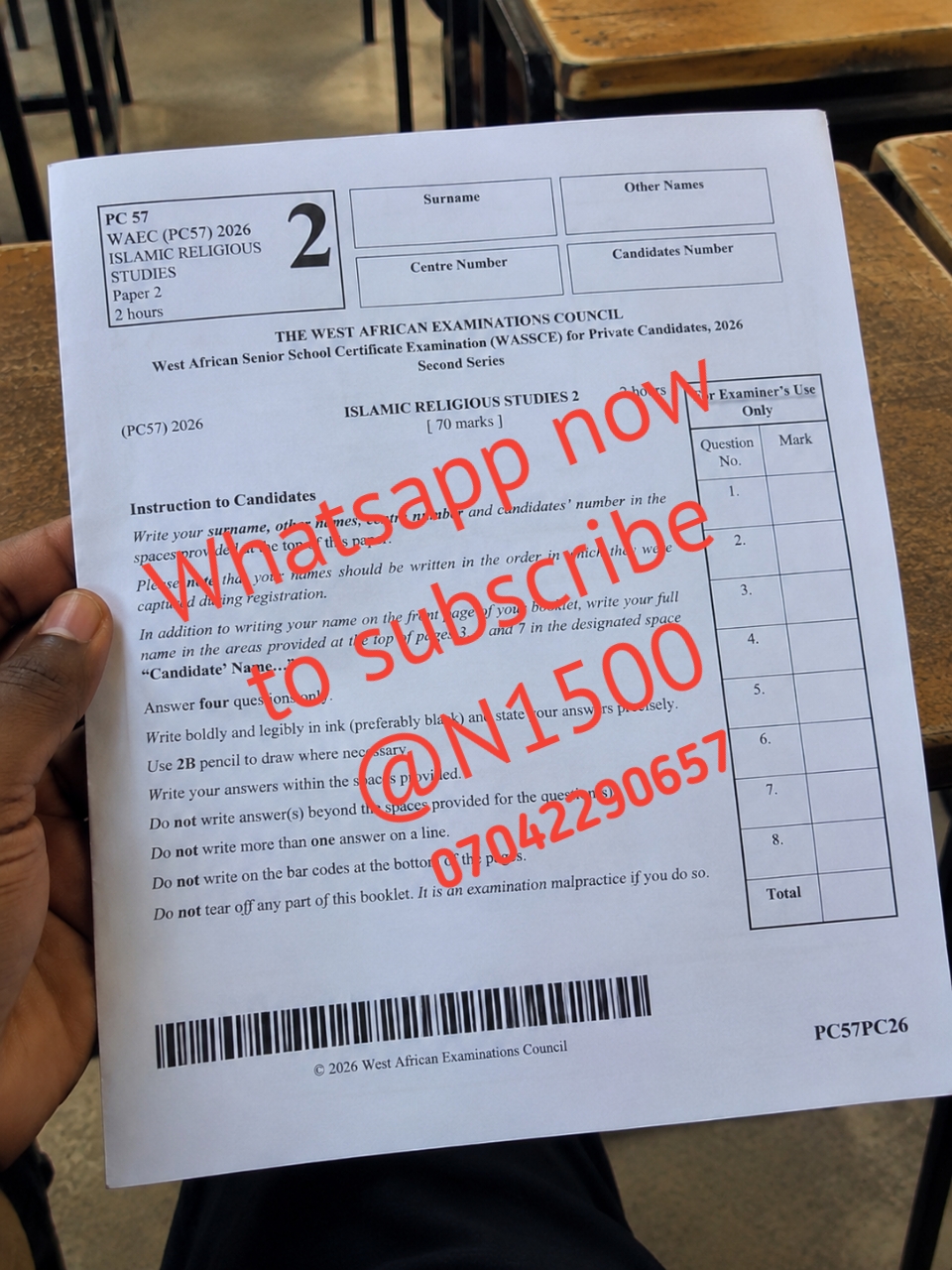
CLICK HERE TO CHAT US ON WHATSAPP TO PAY AND GET IT IMMEDIATELY
CORRECT: 2026 WAEC GCE IRS expo Questions And Answers
The West African Examinations Council (Private WAEC) has officially scheduled the 2026 WAEC GCE IRS paper to take place on Friday 9th October 2026.
As the exam date approaches, many students are actively searching for WAEC GCE 2026 IRS questions and Answers, WAEC GCE IRS expo 2026 Essay and OBJ, 2026 WAEC GCE IRS Expo, IRS WAEC 2026 Questions and Answers, and other trusted study materials. Rest assured, you have come to the right place.
WAEC is responsible for assessing the academic performance of secondary school students across West Africa.
Are you writing the WAEC 2026 exam? Are you looking for verified WAEC GCE IRS answers? Welcome to this page, the most reliable source for genuine 2026 WAEC GCE IRS expo answers, covering both Essay, and Objective (OBJ) sections.
At MASTERJOB, we don’t just make promises—we deliver. Our early and accurate delivery gives you enough time to study, practice, and build confidence before entering the exam hall. We are the top-rated WAEC Runz/Expo provider, trusted by thousands of candidates and school owners.
If you are determined to score an A1 in WAEC GCE IRS this is your best opportunity. With MASTERJOB guiding you, success is guaranteed.
Join us on WhatsApp at 07042290657 for early access to the IRS questions and answers, delivered at least 4 hours before the exam begins.
NOW AVAILABLE WITH US, CLICK HERE TO SUBSCRIBE NOW ON WHATSAPP
What To Expect In The 2026 WAEC GCE IRSexpo Package?
Our comprehensive package includes:
- WAEC GCE IRS essay Questions & Answers 2026
- WAEC GCE IRS objectives Questions & Answers 2026
- WAEC GCE IRS Theory Questions & Answers 2026
All answers are 100% verified and compiled by IRS experts with years of experience preparing candidates for WAEC exams.
2026 WAEC Expo Subscription Plans
Gain access to verified WAEC 2026 questions and answers delivered directly to your device.
Subscription Packages:
- All Subjects (Science, Art & Commercial):
- Science Department Only
- Art Department Only
- Commercial Department Only
- Daily Subscription
Choose your preferred department/subject and Contact us on WhatsApp at to get payment details and secure your slot today 07042290657.
CHAT WITH US ON WHATSAPP TO REGISTER AND ACCESS IT NOW
Subjects Offered For The 2026 WAEC Expo
At MASTERJOB, we cover all approved WAEC subjects, including:
- English Language
- Mathematics
- Biology
- Chemistry
- Physics
- Agricultural Science
- Animal Husbandry
- Computer Studies
- Civic Education
- Data Processing
- Financial Accounting
- CRS
- Government
- Further Mathematics
- Geography
- Literature-in-English
- Visual Art
- Office Practice
- Islamic Religious Studies (IRS)
- Christian Religious Studies (CRS)
- Igbo
- Yoruba
- Hausa
- Bookkeeping and more.
How To Subscribe For 2026 WAEC GCE IRS questions And Answers
STEP 1: Make a payment of N1000 or MTN Recharge Card. Ask for the details here
STEP 2: Send your payment details to WhatsApp using this format:
- Subject: IRS
- Your Full Name
- MTN Card PIN or Proof of Payment
- Active Phone Number
STEP 3: Once confirmed, you will be added to our VIP delivery group for early access.
Note: We don’t offer free stuffs, All questions and answers are released at midnight or at least 4 hours before the exam begins.
WAEC Islamic Studies Areas of Concentration 2026/2027: Exam & Study Guide
Here in this guide we provides the WAEC Islamic Studies areas of concentration, important topics to revise, examination format, marking approach, likely question patterns and practical preparation tips for candidates.
WAEC Islamic Studies Areas of Concentration 2026/2027: Likely Topics, GCE Exam Format, Marking Scheme & Questions
Preparing for WAEC Islamic Studies 2026/2027 requires a good understanding of the Qur’an, Hadith, Islamic history, Tawhid, Fiqh, worship and Islamic moral teachings.
Whether you are preparing for theWAEC GCE, knowing the major areas covered by the syllabus can make revision more organised and effective.
The topics highlighted here are intended to help students prioritise their revision. They should not be regarded as leaked WAEC questions or guaranteed questions.
Disclaimer: This article is strictly for educational and examination-preparation purposes. The areas of concentration and likely questions discussed here are based on the subject syllabus, common examination themes and revision needs. They are not leaked WAEC questions, official predictions or guaranteed questions. WAEC may set questions from any part of the approved syllabus. Candidates preparing for WASSCE or GCE should study the complete syllabus and use official WAEC information where available.
WAEC GCE Islamic Studies 2026/2027
Islamic Studies is examined under different WAEC examination arrangements, including the WASSCE for school candidates and WASSCE for private candidates (GCE).
Although candidates should always confirm the examination timetable and instructions applicable to their own examination, preparation should cover the major areas of the Islamic Studies syllabus rather than relying on one particular examination date.
This guide is therefore useful for:
- WAEC May/June candidates
- WAEC GCE candidates
- School candidates
- Private candidates
- Students revising Islamic Religious Studies
- Candidates looking for Islamic Studies past-question practice
WAEC Islamic Studies Examination Format
Before concentrating on individual topics, candidates should understand the type of questions they are likely to encounter.
The examination generally tests candidates through objective and essay/theory components, with questions drawn from different sections of the Islamic Studies syllabus.
Objective Questions
The objective section tests candidates’ knowledge and understanding of areas such as:
- Islamic history
- Qur’an
- Hadith
- Tawhid
- Fiqh
- Islamic practices
- Islamic terminology
- Moral teachings
- Important personalities and events
Candidates should avoid preparing for the objective paper by memorising isolated facts alone. Understanding the relationship between events, personalities and Islamic teachings is important.
Essay/Theory Questions
The essay section requires candidates to explain, discuss, identify, describe or analyse Islamic teachings and historical events.
Questions may ask candidates to:
- Explain Islamic concepts.
- Discuss the life of Prophet Muhammad (SAW).
- State lessons from historical events.
- Explain the importance of acts of worship.
- Discuss Qur’anic teachings.
- Explain selected Hadith.
- Compare Islamic concepts.
- State and explain moral lessons.
- Discuss Islamic institutions and practices.
WAEC Islamic Studies Marking Scheme
Candidates should understand how to approach theory questions because simply mentioning a topic may not earn all the available marks.
For questions requiring several points, each relevant point should be clearly stated and explained where necessary.
Example
Question: State five benefits of fasting in Islam.
A strong answer could include:
- Develops self-discipline – Fasting teaches Muslims to control their desires and behaviour.
- Strengthens piety – It encourages consciousness of Allah.
- Promotes empathy – Experiencing hunger can increase concern for people who are less privileged.
- Encourages patience – Muslims learn to exercise restraint and perseverance.
- Promotes obedience – Fasting demonstrates obedience to Allah’s command.
This is better than writing five single words without explanations when the question requires discussion.
WAEC Islamic Studies Grading System
WAEC results are reported using grades ranging from A1 to F9.
| Grade | Interpretation |
|---|---|
| A1 | Excellent |
| B2 | Very Good |
| B3 | Good |
| C4 | Credit |
| C5 | Credit |
| C6 | Credit |
| D7 | Pass |
| E8 | Pass |
| F9 | Fail |
Candidates should note that they should not rely on claims such as “you need exactly 75 marks for A1.” WAEC’s grading and standard-setting process means that a simple fixed raw-score table should not be presented as an official guarantee for every examination.
WAEC GCE Islamic Studies Areas of Concentration 2026/2027
The following areas deserve serious attention during revision.
1. Life of Prophet Muhammad (SAW)
The life and mission of Prophet Muhammad (SAW) form a major part of Islamic Studies.
Candidates should revise:
- His birth and early life
- His family background
- His marriage
- The first revelation
- The beginning of his prophethood
- Early Muslims
- Persecution in Makkah
- Hijrah
- Establishment of the Madinan community
- Leadership
- Major battles
- Treaty of Hudaybiyyah
- Conquest of Makkah
- Farewell Pilgrimage
- His final days and death
Likely Revision Questions
- Describe the circumstances surrounding the first revelation.
- Explain the significance of the Hijrah.
- State lessons from the leadership of Prophet Muhammad (SAW).
- Discuss the importance of the Treaty of Hudaybiyyah.
- Explain lessons Muslims can learn from the Conquest of Makkah.
These are practice questions, not predictions of the actual WAEC examination.
2. Arabia Before Islam
Candidates should understand the society in Arabia before the emergence of Islam.
Study:
- Religious practices
- Idol worship
- Social structure
- Marriage
- Treatment of women
- Economic activities
- Political organisation
- Tribal relationships
- Moral conditions
Also understand how Islam transformed many aspects of Arabian society.
3. The Rightly Guided Caliphs
The Khulafa’ur Rashidun are another important area.
Study the leadership of:
- Abu Bakr (RA)
- Umar ibn al-Khattab (RA)
- Uthman ibn Affan (RA)
- Ali ibn Abi Talib (RA)
For each personality, revise:
- Background
- Accession to leadership
- Major achievements
- Challenges
- Contributions to Islam
- Leadership lessons
Possible Questions
1. State five contributions of Umar ibn al-Khattab (RA) to the development of the Islamic state.
2. Discuss the leadership qualities demonstrated by Abu Bakr (RA).
4. Islam in West Africa
This area is particularly relevant to candidates studying Islamic history.
Revise:
- Introduction of Islam into West Africa
- Trans-Saharan trade
- Muslim traders
- Muslim scholars
- Islamic education
- Muslim rulers
- Development of Islamic centres
- Influence of Islam on West African societies
Candidates should also understand the historical importance of:
- Ghana Empire
- Mali Empire
- Songhai Empire
- Kanem-Borno
5. Revelation and Preservation of the Qur’an
This is a major Qur’anic Studies topic.
Candidates should study:
- Meaning of revelation
- First revelation
- Cave Hira
- Prophet Muhammad’s (SAW) experience of revelation
- Compilation of the Qur’an
- Preservation of the Qur’an
- Standardisation of the written Qur’an
Pay attention to the historical role of the early Muslim community in preserving and transmitting the Qur’an.
6. Selected Qur’anic Surahs
Candidates should carefully study the selected Surahs prescribed for their examination.
Focus on:
- Meaning
- Main teachings
- Context
- Moral lessons
- Application to everyday life
Do not simply memorise the Arabic text. Understand what the Surah teaches and how those teachings apply to Muslim life.
7. Hadith
Candidates should revise the prescribed Hadith and understand:
- Meaning
- Main message
- Lessons
- Moral teachings
- Application in daily life
Questions may require candidates to explain what a particular Hadith teaches about individual and social behaviour.
8. Articles of Faith — Iman
This is an important Tawhid area.
Candidates should know the six articles of faith:
- Belief in Allah
- Belief in His angels
- Belief in His revealed books
- Belief in His prophets
- Belief in the Day of Judgment
- Belief in Qada and Qadar
Students should be able to explain the significance of each article rather than merely listing them.
9. Shirk and Tawhid
Study:
- Meaning of Tawhid
- Meaning of Shirk
- Forms of Shirk
- Causes of Shirk
- Consequences of Shirk
- Importance of belief in the oneness of Allah
This topic can appear through both objective questions and explanatory questions.
10. Taharah — Purification
Candidates should understand Islamic purification practices, including:
- Istinja
- Wudu
- Ghusl
- Tayammum
Focus on:
- Meaning
- Conditions
- Procedures
- Importance
- Situations in which each form of purification applies
11. Salat
Prayer is one of the most important areas of Fiqh.
Revise:
- Meaning of Salat
- Importance of prayer
- Five daily prayers
- Conditions for valid Salat
- Obligatory acts
- Friday prayer
- Janazah prayer
- Voluntary prayers
- Prayer during travel
Candidates should understand both the rules and significance of Salat.
12. Sawm — Fasting
Study:
- Meaning of Sawm
- Ramadan
- Obligatory fasting
- Voluntary fasting
- Exemptions
- Things that invalidate fasting
- Benefits of fasting
- Moral significance of fasting
Possible Revision Question
Explain five benefits of fasting to an individual Muslim and the wider society.
13. Zakat and Sadaqah
Candidates should understand:
- Meaning of Zakat
- Importance of Zakat
- Nisab
- Eligible beneficiaries
- Zakatul-Fitr
- Difference between Zakat and Sadaqah
- Social importance of charity
Questions may focus on how Zakat contributes to social welfare and economic justice.
14. Hajj and Umrah
Revise:
- Meaning of Hajj
- Significance of Hajj
- Conditions for Hajj
- Rites of Hajj
- Ihram
- Tawaf
- Sa’i
- Arafat
- Mina
- Muzdalifah
- Spiritual lessons from Hajj
Candidates should understand the order and significance of the major rites, not merely memorise their names.
15. Shari’ah and Sources of Islamic Law
Study the meaning and sources of Islamic law.
Important sources include:
- Qur’an
- Sunnah
- Ijma
- Qiyas
Candidates should understand the role of each source and how Islamic legal principles are derived.
16. Islamic Marriage — Nikah
Important areas include:
- Meaning of Nikah
- Purpose of marriage
- Conditions of valid marriage
- Rights of husband
- Rights of wife
- Responsibilities of spouses
- Prohibited marriages
- Importance of family in Islam
17. Divorce — Talaq
Candidates should study:
- Meaning of Talaq
- Islamic position on divorce
- Types of divorce
- Iddah
- Rights and responsibilities after divorce
- Reconciliation
- Social effects of divorce
Questions may require candidates to explain why Islam regulates divorce and promotes reconciliation.
Most Important WAEC Islamic Studies Topics to Revise
If you have limited time, start with:
- Life and leadership of Prophet Muhammad (SAW)
- Qur’an revelation and preservation
- Selected Qur’anic passages
- Hadith and their teachings
- Articles of Faith
- Tawhid and Shirk
- Taharah
- Salat
- Sawm
- Zakat
- Hajj
- Islamic marriage and divorce
- Khulafa’ur Rashidun
- Islam in West Africa
- Sources of Islamic law
However, do not abandon the remaining syllabus simply because these areas are considered important.
WAEC GCE Islamic Studies 2026/2027 Likely Questions for Practice
Here are some useful questions candidates can practise:
Objective Practice
- What is meant by Tawhid?
- Which of the following represents one of the articles of Iman?
- What was the significance of the first revelation?
- What is the meaning of Zakat?
- Which act is associated with Hajj?
- What is Tayammum?
- Who was the first Caliph after Prophet Muhammad (SAW)?
- What is the significance of Hijrah?
- What is meant by Shirk?
- Which of the following is a source of Islamic law?
Theory Practice
1. Explain five lessons Muslims can learn from the life of Prophet Muhammad (SAW).
2. Discuss the importance of Hijrah in the history of Islam.
3. Explain the six articles of faith.
4. State and explain five benefits of Salat.
5. Explain five benefits of fasting in Islam.
6. Discuss the importance of Zakat in Muslim society.
7. Describe the major rites of Hajj.
8. Explain five contributions of the Rightly Guided Caliphs to Islam.
9. Discuss the role of Muslim traders and scholars in the spread of Islam in West Africa.
10. Explain the importance of the Qur’an as a source of guidance for Muslims.
These questions are revision exercises, not leaked questions or guarantees of what will appear in WAEC or GCE.
How to Score High in WAEC Islamic Studies 2026/2027
Understand Arabic and Islamic Terms
Don’t memorise terms without knowing their meanings.
For example, make sure you understand terms such as:
Tawhid, Shirk, Iman, Sawm, Salat, Zakat, Hajj, Sunnah, Ijma, Qiyas, Nikah, Talaq and Iddah.
Study the Qur’an and Hadith Properly
Where prescribed passages or Hadith are part of your syllabus, study their meanings and lessons carefully.
Practise Past Questions
Past questions are valuable because they show how topics are converted into objective and essay questions.
Learn Historical Sequences
For Islamic history, create timelines.
For example:
Birth → Prophethood → Migration → Madinah → Major events → Conquest of Makkah → Farewell Pilgrimage
This makes historical revision easier.
Learn Lessons From Events
Don’t only memorise what happened.
Ask:
- Why did it happen?
- What was the outcome?
- What lesson does it teach?
- How can Muslims apply that lesson today?
WAEC GCE Islamic Studies Preparation Tips 2026/2027
Candidates sitting for WAEC GCE Islamic Studies should use the same disciplined approach.
Because private candidates may have different preparation circumstances from school candidates, it is particularly important to:
- Obtain the current syllabus.
- Confirm the official GCE timetable.
- Practise previous questions.
- Create a personal revision timetable.
- Study Qur’an and Hadith materials carefully.
- Cover both history and Fiqh.
- Practise writing complete theory answers.
- Avoid relying on social media “sure questions.”
Final Advice
The best preparation for WAEC Islamic Studies 2026/2027 and GCE is not memorising a list of supposed “expo questions.”
Candidates should understand the syllabus, study the prescribed Qur’anic and Hadith materials, revise Islamic history, master important Fiqh concepts and practise past questions.
Pay particular attention to Prophet Muhammad’s (SAW) life, Qur’an and Hadith, Tawhid, Iman, Salat, Sawm, Zakat, Hajj, Islamic history and Islamic moral teachings, while still covering the complete syllabus.
A candidate who understands the subject and can clearly explain Islamic teachings is better prepared for both objective and essay questions.
Final Disclaimer: The areas of concentration and practice questions in this article are provided solely as revision guidance. They are not leaked WAEC/GCE questions, official WAEC predictions or guaranteed questions. WAEC can set questions from any area of the approved syllabus. Always verify examination dates, requirements and other official information through WAEC or your school/approved examination centre.
Frequently Asked Questions
What are the WAEC Islamic Studies areas of concentration for 2026/2027?
Important areas include the life of Prophet Muhammad (SAW), Qur’an, Hadith, Tawhid, Iman, Fiqh, Salat, Sawm, Zakat, Hajj, Islamic history and Islam in West Africa.
Does this guide apply to WAEC GCE?
Yes. The guide can help candidates preparing for WAEC GCE Islamic Studies, although candidates should always check the syllabus and examination information applicable to their particular GCE sitting.
Are these guaranteed WAEC Islamic Studies questions?
No. They are revision topics and practice questions, not leaked or guaranteed questions.
How can I get A1 in Islamic Studies?
Study the complete syllabus, understand the prescribed Qur’an and Hadith materials, practise past questions, learn important Islamic terms and practise writing well-explained theory answers.
Is Islamic Studies difficult in WAEC?
It can become much easier when candidates understand the historical events, Islamic concepts and reasons behind different practices instead of relying entirely on memorisation.
Related WAEC Guides
- WAEC Government Areas of Concentration 2026/2027
- WAEC Civic Education Areas of Concentration 2026/2027
- WAEC CRS Areas of Concentration 2026/2027
- WAEC English Language Exam Format and Marking Scheme
- WAEC Timetable 2026: Complete May/June Examination Schedule
- Waec gce economic preparation guide 2026/2027