
2026 WAEC GCE Economic questions and Answers Expo: In today’s article, we have shared the verified 2026 WAEC GCE Economics expo questions and answers for Essay and Objective (OBJ) delivered early and reliably.
CLICK HERE TO CHAT US ON WHATSAPP TO PAY AND GET IT IMMEDIATELY
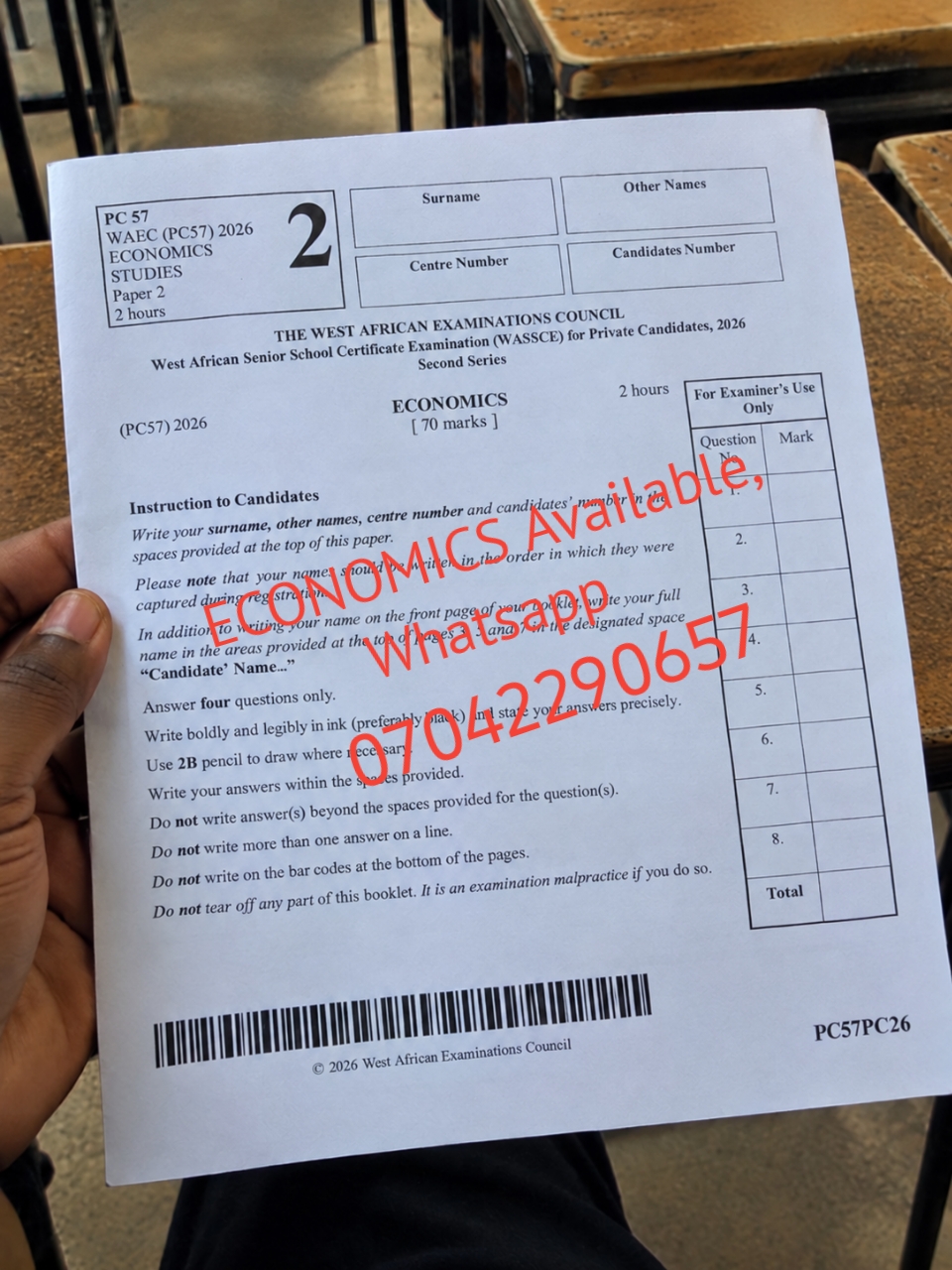
CORRECT: 2026 WAEC GCE Economic expo Questions And Answers
The West African Examinations Council (Private WAEC) has officially scheduled the 2026 WAEC GCE Economics paper to take place on Saturday 10th October 2026.
As the exam date approaches, many students are actively searching for WAEC GCE 2026 Economics questions and Answers, WAEC GCE Economics expo 2026 Essay and OBJ, 2026 WAEC GCE Economic Expo, Economics WAEC 2026 Questions and Answers, and other trusted study materials. Rest assured, you have come to the right place.
WAEC is responsible for assessing the academic performance of secondary school students across West Africa.
Are you writing the WAEC 2026 exam? Are you looking for verified WAEC GCE Economics answers? Welcome to this page, the most reliable source for genuine 2026 WAEC GCE Economic expo answers, covering both Essay, and Objective (OBJ) sections.
At MASTERJOB, we don’t just make promises—we deliver. Our early and accurate delivery gives you enough time to study, practice, and build confidence before entering the exam hall. We are the top-rated WAEC Runz/Expo provider, trusted by thousands of candidates and school owners.
If you are determined to score an A1 in WAEC GCE Economic this is your best opportunity. With MASTERJOB guiding you, success is guaranteed.
Join us on WhatsApp at 07042290657 for early access to the Economics questions and answers, delivered at least 4 hours before the exam begins.
NOW AVAILABLE WITH US, CLICK HERE TO SUBSCRIBE NOW ON WHATSAPP
What To Expect In The 2026 WAEC GCE Economics expo Package?
Our comprehensive package includes:
- WAEC GCE Economic essay Questions & Answers 2026
- WAEC GCE Economics objectives Questions & Answers 2026
- WAEC GCE Economic Theory Questions & Answers 2026
All answers are 100% verified and compiled by Economics experts with years of experience preparing candidates for WAEC exams.
2026 WAEC Expo Subscription Plans
Gain access to verified WAEC 2026 questions and answers delivered directly to your device.
Subscription Packages:
- All Subjects (Science, Art & Commercial):
- Science Department Only
- Art Department Only
- Commercial Department Only
- Daily Subscription
Choose your preferred department/subject and Contact us on WhatsApp at to get payment details and secure your slot today 07042290657.
CHAT WITH US ON WHATSAPP TO REGISTER AND ACCESS IT NOW
Subjects Offered For The 2026 WAEC Expo
At MASTERJOB, we cover all approved WAEC subjects, including:
- English Language
- Mathematics
- Biology
- Chemistry
- Physics
- Agricultural Science
- Animal Husbandry
- Computer Studies
- Civic Education
- Data Processing
- Financial Accounting
- Economics
- Government
- Further Mathematics
- Geography
- Literature-in-English
- Visual Art
- Office Practice
- Islamic Religious Studies (IRS)
- Christian Religious Studies (CRS)
- Igbo
- Yoruba
- Hausa
- Bookkeeping and more.
How To Subscribe For 2026 WAEC GCE Economics questions And Answers
STEP 1: Make a payment of N1500 or MTN Recharge Card. Ask for the details here
STEP 2: Send your payment details to WhatsApp using this format:
- Subject: Economic
- Your Full Name
- MTN Card PIN or Proof of Payment
- Active Phone Number
STEP 3: Once confirmed, you will be added to our VIP delivery group for early access.
Note: We don’t offer free stuffs, All questions and answers are released at midnight or at least 4 hours before the exam begins.
Related Articles:
WAEC GCE Timetable 2026: Second Series Exam Dates, Subjects & PDF Download
WAEC GCE Livestock Farming 2026/2027: Key Topics, Practical Guide & Exam Preparation
WAEC GCE Digital Technologies 2026/2027: Key Topics, Syllabus & Exam Preparation Guide
WAEC Economics 2026 Questions and Answers (Essay & Objectives)
WAEC Financial Accounting 2026 Questions And Answers (Essay & Objectives)
WAEC Timetable 2026 for May/June Exam Released: Full Schedule & Best Preparation Tips For Candidates
WAEC GCE 2026 Economic Preparation
Preparing for WAEC GCE Economics 2026? This guide brings together the major Economics topics candidates should revise, important concepts to understand, calculations and diagrams to practise, and lessons from previous WAEC examination questions.
Economics is not simply a subject of definitions. Candidates are expected to understand economic concepts and apply them to real situations involving consumers, businesses, government and the wider economy.
For that reason, effective preparation should combine theory, calculations, diagrams and past-question practice.
WAEC GCE Economics Examination Structure 2026/2027
For the 2026 WASSCE for private Candidates in Nigeria, WAEC scheduled Economics on 10th October.
For the GCE/private-candidate examination, candidates should use the timetable released for their particular examination series rather than assuming that the school-candidate timetable applies.
The examination requires more than memorising definitions. You should be prepared to:
- Define economic concepts
- Explain economic relationships
- Interpret data
- Perform calculations
- Draw and interpret diagrams
- Apply economic principles to real-life situations
Important WAEC GCE Economics Topics to Study in 2026/2027
1. Basic Economic Concepts
Begin with the foundations of Economics.
Study:
- Meaning of Economics
- Scarcity
- Choice
- Scale of preference
- Opportunity cost
- Wants
- Needs
- Economic resources
- Free goods
- Economic goods
Opportunity Cost
Opportunity cost is the value of the next best alternative forgone when a choice is made.
For example, if a student has ₦5,000 and chooses to buy a textbook instead of using the money to purchase a pair of shoes, the opportunity cost is the benefit the student would have obtained from the shoes.
This is more useful than memorising the definition alone because WAEC may test the concept through a situation.
2. Factors of Production
Understand the four major factors of production:
| Factor | Reward |
|---|---|
| Land | Rent |
| Labour | Wages |
| Capital | Interest |
| Entrepreneur | Profit |
Also study:
- Characteristics of each factor
- Mobility
- Importance
- Division of labour
- Specialisation
Don’t confuse capital in Economics with money alone. Capital refers to produced resources used in further production, such as machinery, equipment and factories.
3. Demand and Supply
This should receive serious attention.
Demand
Study:
- Meaning of demand
- Law of demand
- Demand schedule
- Demand curve
- Determinants of demand
- Movement along a demand curve
- Shift in demand curve
Supply
Study:
- Meaning of supply
- Law of supply
- Supply schedule
- Supply curve
- Determinants of supply
- Movement along supply curve
- Shift in supply curve
Market equilibrium
Understand how demand and supply interact to determine equilibrium price and quantity.
WAEC’s past Economics questions have tested candidates on demand and supply schedules, curves, equilibrium price and quantity, and excess supply.
So don’t merely memorise the laws.
Practise drawing the curves and solving questions from tables or equations.
4. Elasticity
Another important area is elasticity.
Study:
- Price elasticity of demand
- Income elasticity of demand
- Cross elasticity of demand
- Elasticity of supply
Candidates should know how to:
- Calculate elasticity
- Interpret the answer
- Distinguish elastic from inelastic demand
- Explain factors affecting elasticity
This is one of the areas where practising calculations is much more useful than reading definitions repeatedly.
5. Price Determination and Price Control
Study:
- Equilibrium price
- Maximum price
- Minimum price
- Price ceiling
- Price floor
- Shortage
- Surplus
- Black market
WAEC examiner feedback shows that candidates have struggled with questions involving price controls and diagrams. One previous question required candidates to explain the effects of fixing prices above and below equilibrium, including surplus, shortage and possible black-market activity.
6. Theory of Consumer Behaviour
Revise:
- Utility
- Total utility
- Marginal utility
- Law of diminishing marginal utility
- Consumer equilibrium
Understand the relationship between total and marginal utility.
Practise questions involving tables because WAEC can test the concept numerically.
7. Production
Study:
- Meaning of production
- Types of production
- Factors affecting production
- Division of labour
- Specialisation
- Advantages of specialisation
- Disadvantages of division of labour
- Productivity
- Efficiency
Also understand how production decisions affect costs and output.
8. Cost and Revenue
This is an area where calculations matter.
Revise:
- Fixed cost
- Variable cost
- Total cost
- Average cost
- Marginal cost
- Total revenue
- Average revenue
- Marginal revenue
Know the relationships between these concepts.
For example:
Total Cost = Fixed Cost + Variable Cost
Don’t just memorise the formula. Practise questions where information is provided in a table and you have to calculate missing values.
9. Market Structures
Study the characteristics of:
- Perfect competition
- Monopoly
- Monopolistic competition
- Oligopoly
For each one, know:
- Number of firms
- Nature of product
- Entry and exit
- Price control
- Competition
- Examples
- Advantages and disadvantages
WAEC has previously used diagrams and calculations to test market structures and firm equilibrium.
10. Money
Understand:
- Meaning of money
- Characteristics of money
- Functions of money
- Importance of money
- Value of money
The four traditional functions include:
- Medium of exchange
- Measure of value
- Store of value
- Standard of deferred payment
A strong candidate should also understand how inflation can affect these functions.
WAEC examiner feedback has specifically tested this relationship in previous Economics examinations.
11. Banking and Monetary Policy
Study:
Commercial banks
- Functions
- Sources of income
- Credit creation
- Loans and advances
Central bank
Understand the functions of the Central Bank of Nigeria, including:
- Banker to government
- Banker to commercial banks
- Issuing currency
- Monetary policy
- Foreign exchange management
- Banking supervision
Also revise:
- Monetary policy
- Bank rate
- Open market operations
- Reserve requirements
12. Inflation
Inflation deserves special attention.
Study:
- Meaning of inflation
- Demand-pull inflation
- Cost-push inflation
- Causes
- Effects
- Control measures
- Inflation and purchasing power
Don’t stop at the definition.
WAEC examiner reports show that candidates have often been able to define inflation but struggled to explain its causes and effects adequately.
That gives us a very useful preparation lesson:
In Economics, explaining a point is often more important than merely listing it.
13. Public Finance and Taxation
Study:
- Government revenue
- Taxation
- Direct taxes
- Indirect taxes
- Progressive tax
- Proportional tax
- Regressive tax
- Principles of taxation
- Public expenditure
- Government budget
- Budget deficit
- Budget surplus
Candidates should understand how taxation affects individuals, businesses and government revenue.
14. National Income
This is one of the areas where calculations are particularly important.
Study:
- GDP
- GNP
- NNP
- National income
- Per capita income
- Nominal GDP
- Real GDP
- Methods of measuring national income
- Problems of measurement
Practise calculations.
WAEC has previously asked candidates to calculate GDP, GNP, NNP and per-capita income and explain problems associated with measuring national income.
Example
If national income is ₦10 billion and population is 2 million:
Per capita income = National income ÷ Population
= ₦10,000,000,000 ÷ 2,000,000
= ₦5,000
The important thing is to understand what the result represents.
15. Economic Growth and Development
Understand the difference between:
Economic growth and economic development.
Study:
- Meaning of economic growth
- Economic development
- Indicators of development
- Factors affecting development
- Development planning
- Problems of developing economies
Use Nigerian examples when practising application questions.
16. International Trade
Study:
- Meaning of international trade
- Imports
- Exports
- Balance of trade
- Balance of payments
- Terms of trade
- Exchange rate
- Advantages of international trade
- Problems of international trade
Understand why countries trade with one another and how international trade affects an economy.
17. Exchange Rate
Revise:
- Meaning of exchange rate
- Appreciation
- Depreciation
- Devaluation
- Fixed exchange rate
- Flexible exchange rate
- Factors affecting exchange rates
- Effects of exchange-rate changes
Candidates should be able to explain how exchange-rate changes can affect imports, exports, consumers and businesses.
18. Economic Integration
Study:
- ECOWAS
- AfCFTA
- Free trade area
- Customs union
- Common market
- Economic union
Know the reasons countries form economic groups and the potential benefits and challenges.
19. Population
Important areas include:
- Meaning of population
- Population census
- Population density
- Population distribution
- Population growth
- Optimum population
- Overpopulation
- Underpopulation
- Effects of population growth
- Population policies
Candidates should also understand the difference between population size, density and distribution.
20. Agriculture and Natural Resources
Study:
- Importance of agriculture
- Problems of agricultural production
- Agricultural financing
- Land ownership
- Mechanisation
- Marketing
- Agricultural development
- Natural resources
Try to connect economic theory to real Nigerian examples.
WAEC GCE Economics Calculations You Should Practise 2026/2027
Don’t prepare for Economics without practising calculations.
Work on:
- Elasticity
- Total cost
- Average cost
- Marginal cost
- Revenue
- Profit
- National income
- GDP
- GNP
- NNP
- Per capita income
- Demand and supply equations
- Equilibrium price and quantity
Economics Diagrams You Should Know In 2026/2027 WAEC
Practise drawing and interpreting:
- Demand curve
- Supply curve
- Equilibrium
- Changes in demand
- Changes in supply
- Price controls
- Cost curves
- Revenue curves
- Market structure diagrams
A diagram should not just be memorised. Know what causes the curve to move and what the movement means.
What WAEC Examiner Reports Can Teach You
This is one of the new sections I’d deliberately add to the recovered article.
WAEC’s e-Learning platform says its resources are designed to help students understand the standards required in examinations and includes analysis of candidates’ strengths and weaknesses.
For Economics, previous examiner feedback gives us several useful lessons.
Candidates often lose marks by:
- Giving definitions without explanations
- Listing points without elaborating
- Struggling with calculations
- Poor interpretation of diagrams
- Avoiding difficult economic questions
- Failing to apply concepts to situations
For example, WAEC’s examiner feedback on inflation shows that many candidates could define inflation but struggled to explain causes and effects adequately.
Therefore, your revision should follow this pattern:
Define → Explain → Give an example → Apply
That’s much stronger preparation than memorising four bullet points.
How to Study Economics for WAEC GCE 2026/2027
First: Understand the concept
Don’t memorise “scarcity means…” without understanding scarcity.
Second: Practise with examples
Use everyday situations.
Third: Solve past questions
Attempt questions without looking at the answers first.
Fourth: Practise calculations separately
Spend time specifically on Economics calculations.
Fifth: Practise diagrams
Draw them from memory and explain what they represent.
Sixth: Review mistakes
Create a small list of concepts you repeatedly get wrong.
High-Priority Revision Checklist
For quick revision, make sure you have covered:
- Basic economic concepts
- Factors of production
- Demand and supply
- Elasticity
- Price determination
- Consumer behaviour
- Production
- Cost and revenue
- Market structures
- Money
- Banking
- Inflation
- Public finance
- Taxation
- National income
- Economic development
- International trade
- Exchange rate
- Economic integration
- Population
- Agriculture
These are areas to revise, not guaranteed questions.
Don’t Depend on WAEC Expo Claims
Candidates should be careful with websites, WhatsApp groups and social-media accounts claiming to have “100% verified” WAEC questions before the examination.
Those claims are not a reliable preparation strategy.
A better approach is to use:
- The official syllabus
- School notes
- Approved textbooks
- Past questions
- WAEC’s e-Learning resources
- Examiner feedback
- Qualified teachers
WAEC’s official Economics e-Learning section provides past examination materials and examiner observations that can be used to understand the required standard.
Final Thoughts
Preparing for WAEC GCE Economics requires more than memorising definitions or trying to predict the examination.
Build a strong understanding of economic concepts, practise calculations, learn how to interpret diagrams and use previous WAEC questions to identify areas that need more work.
Most importantly, don’t restrict your preparation to a list of “likely questions.” Understand the underlying Economics.
That is what allows you to handle questions even when WAEC changes the wording or presents a familiar concept in a new situation.
Read Also:
WAEC GCE Livestock Farming 2026/2027: Key Topics, Practical Guide & Exam Preparation
WAEC GCE Digital Technologies 2026/2027: Key Topics, Syllabus & Exam Preparation Guide
WAEC GCE Biology 2026/2027: Important Topics & Exam Practical Guide
WAEC Timetable 2026 for May/June Exam Released: Full Schedule & Best Preparation Tips For Candidates