
Preparing for WAEC Further Mathematics 2026/2027 requires more than memorising formulas. The subject covers advanced mathematical concepts that require regular practice, accurate calculations and a good understanding of how to apply mathematical principles.
This guide covers the major WAEC Further Mathematics areas of concentration for 2026/2027, including the examination structure, likely question areas, marking approach, grading system, important formulas and practical revision strategies.
The topics discussed here should be used as a revision guide, not as leaked or guaranteed examination questions. WAEC does not officially publish future examination questions before the examination.
WAEC Further Mathematics 2026 Questions and Answers
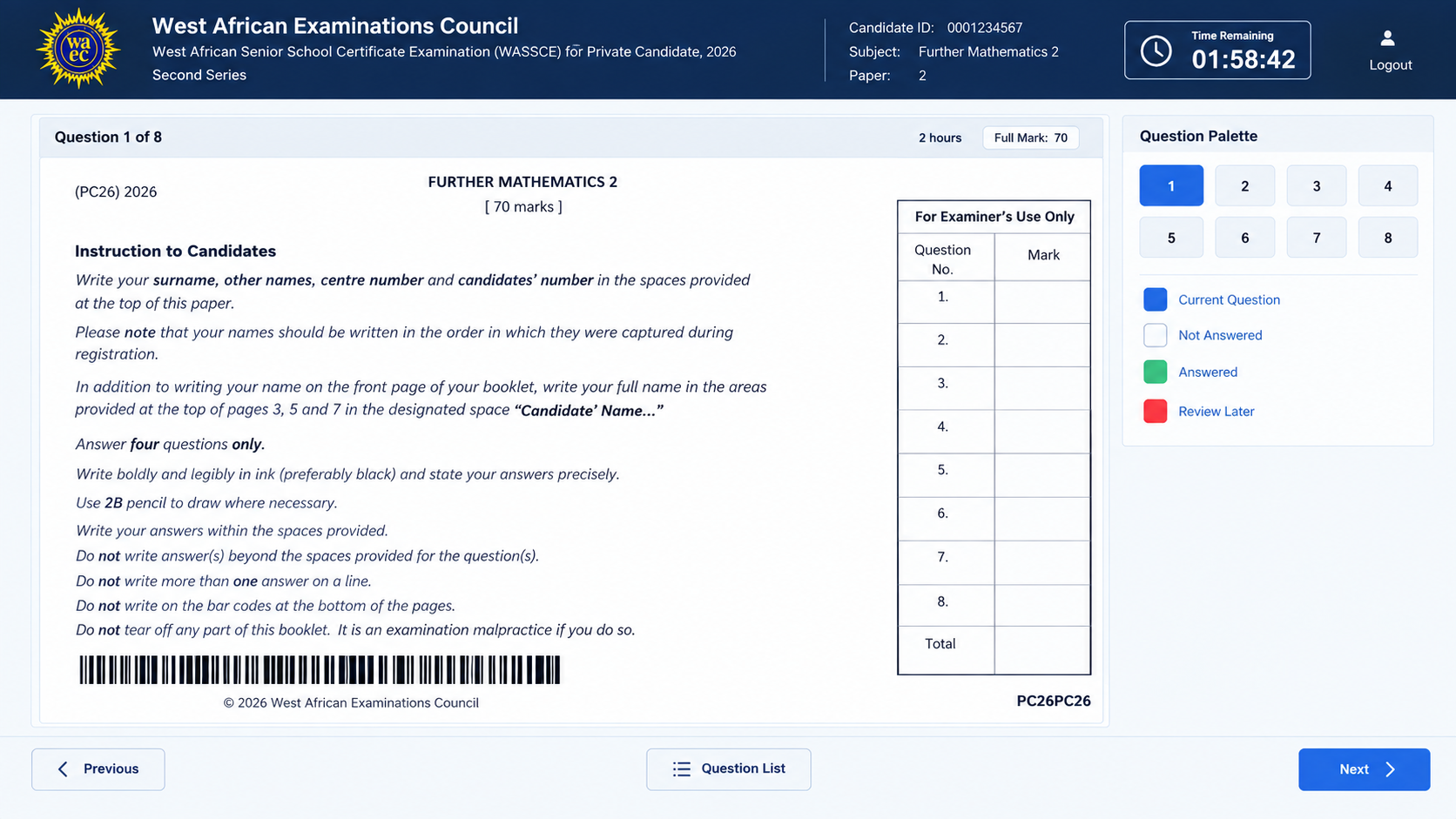
WAEC Further Mathematics is designed to test candidates’ ability to understand and apply advanced mathematical concepts.
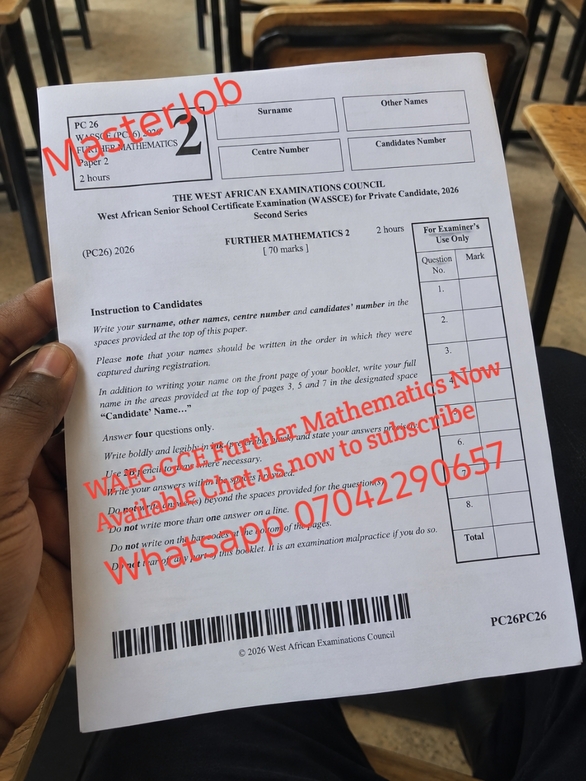
Get Questions and Answers Here:
2026 WAEC GCE Mathematics Questions and Answers (Expo) – 3rd October
The examination generally assesses candidates through objective and essay/problem-solving questions.
Paper 1:
2026 WAEC GCE Further Mathematics Objective Questions
The objective paper tests candidates across different sections of the Further Mathematics syllabus.
Questions may cover areas such as:
- Algebra
- Geometry
- Calculus
- Trigonometry
- Statistics
- Vectors
- Mechanics
- Matrices
- Probability
Candidates should avoid preparing for only one topic because objective questions can be drawn from different parts of the syllabus.
Paper 2:
2026 WAEC GCE Further Mathematics Essay Questions
The theory paper requires candidates to demonstrate their working and mathematical reasoning.
Questions may involve:
- Algebraic manipulation
- Proofs
- Calculations
- Graphs
- Differentiation
- Integration
- Coordinate geometry
- Vectors
- Mechanics
- Statistics and probability
In calculation-based questions, showing the necessary working is extremely important because marks may be awarded for correct steps even when the final answer is wrong.
WAEC Further Mathematics Marking Scheme
The exact allocation of marks can vary according to the examination paper and WAEC’s approved marking scheme.
However, candidates should understand that Further Mathematics is largely step-mark based.
What Examiners Look For
Marks can be awarded for:
- Correct formula
- Correct substitution
- Appropriate mathematical method
- Accurate calculations
- Correct diagrams or graphs
- Logical working
- Correct final answer
- Appropriate units where applicable
For example, if a question requires differentiation and the candidate uses the correct differentiation rule but makes an arithmetic error later, the candidate may still receive marks for the correct method.
Important Marking Advice
Do not write only the final answer.
Show your calculations clearly, especially in:
- Calculus
- Mechanics
- Statistics
- Probability
- Coordinate geometry
- Trigonometry
- Algebra
Clear working makes it easier for the examiner to award method marks.
WAEC GCE Further Mathematics Grading System Explained
WAEC uses a grading system ranging from A1 to F9.
The commonly recognised interpretation is:
| Grade | Interpretation |
|---|---|
| A1 | Excellent |
| B2 | Very Good |
| B3 | Good |
| C4 | Credit |
| C5 | Credit |
| C6 | Credit |
| D7 | Pass |
| E8 | Pass |
| F9 | Fail |
Candidates should note that the final grade is determined by WAEC’s approved standard and marking process. It should not be assumed that a particular raw percentage automatically guarantees a specific grade in every examination.
WAEC GCE Further Mathematics Areas of Concentration 2026/2027
Algebra
Algebra is one of the foundations of Further Mathematics.
Candidates should revise:
- Quadratic equations
- Polynomial equations
- Simultaneous equations
- Inequalities
- Sequences and series
- Binomial expansion
- Mathematical induction
- Functions
- Logarithms
- Indices
Functions
Pay attention to:
- Domain and range
- Composite functions
- Inverse functions
- Function notation
- Graphs of functions
- Transformation of functions
Candidates should practise determining the domain and range of different functions and solving equations involving functions.
Matrices and Determinants
Matrices are important calculation topics.
Study:
- Types of matrices
- Matrix addition
- Matrix multiplication
- Determinants
- Inverse of a matrix
- Simultaneous equations using matrices
Candidates should practise calculations carefully because small arithmetic mistakes can affect the entire answer.
Sequences and Series
Important areas include:
- Arithmetic progression
- Geometric progression
- nth term
- Sum of series
- Infinite geometric series
- Applications of sequences
Pay special attention to questions requiring the identification of the first term, common difference or common ratio.
Binomial Theorem
Candidates should understand:
- Expansion of expressions
- General term
- Coefficients
- Approximation using binomial expansion
Practise both straightforward expansions and questions requiring a particular term.
Trigonometry
Trigonometry remains an important area of mathematical problem solving.
Revise:
- Trigonometric ratios
- Trigonometric identities
- Compound angles
- Double angles
- Multiple angles
- Trigonometric equations
- Graphs of trigonometric functions
- Heights and distances
Candidates should memorise important identities and practise applying them rather than simply memorising formulas.
Coordinate Geometry
Focus on:
- Straight lines
- Gradient
- Distance between two points
- Midpoint
- Equation of a line
- Circles
- Tangents
- Intersections
Questions may require candidates to combine algebra with geometric reasoning.
Vectors
Candidates should study:
- Vector representation
- Addition and subtraction of vectors
- Magnitude
- Unit vectors
- Position vectors
- Scalar multiplication
- Vector geometry
Learn how vectors can be used to solve geometric problems.
Differentiation
Differentiation is one of the most important areas to master.
Study:
- Meaning of differentiation
- Differentiation from first principles
- Differentiation rules
- Product rule
- Quotient rule
- Chain rule
- Stationary points
- Maximum and minimum points
- Rate of change
Candidates should practise identifying whether a stationary point represents a maximum or minimum.
Integration
Revise:
- Indefinite integration
- Definite integration
- Integration techniques
- Integration as the reverse of differentiation
- Areas under curves
- Areas between curves
Always remember the constant of integration when dealing with indefinite integrals.
Statistics
Important areas include:
- Mean
- Median
- Mode
- Variance
- Standard deviation
- Frequency distributions
- Cumulative frequency
- Histograms
- Probability distributions
Candidates should also practise interpreting statistical information rather than focusing only on calculations.
Probability
Study:
- Basic probability
- Sample spaces
- Events
- Independent events
- Mutually exclusive events
- Conditional probability
- Probability distributions
Many probability questions become easier when candidates organise the information carefully before calculating.
Mechanics
Mechanics is another major section of Further Mathematics.
Focus on:
- Motion
- Distance and displacement
- Speed and velocity
- Acceleration
- Newton’s laws
- Forces
- Friction
- Momentum
- Work
- Energy
- Power
Candidates should pay attention to units and carefully identify the forces acting on an object.
Dynamics and Motion
Revise questions involving:
- Uniform acceleration
- Equations of motion
- Vertical motion
- Projectiles
- Force and acceleration
- Momentum
Practise drawing simple diagrams where necessary before starting calculations.
Most Likely WAEC Further Mathematics Objective Areas
For objective revision, give additional attention to:
- Algebra
- Functions
- Matrices
- Sequences and series
- Trigonometry
- Coordinate geometry
- Vectors
- Differentiation
- Integration
- Statistics
- Probability
- Mechanics
Objective questions may combine two or more mathematical concepts, so candidates should practise mixed questions.
Most Likely WAEC Further Mathematics Essay Areas
Candidates should be particularly comfortable solving problems involving:
Algebra and Functions
Possible question styles include:
- Solving equations
- Functions and inverse functions
- Polynomial problems
- Sequences and series
- Binomial expansion
Calculus
Prepare for questions involving:
- Differentiation
- Stationary points
- Maximum and minimum values
- Rates of change
- Integration
- Areas under curves
Coordinate Geometry
Possible areas include:
- Equation of a straight line
- Circle equations
- Tangents
- Distance and midpoint problems
Statistics and Probability
Revise:
- Mean and variance
- Standard deviation
- Probability
- Frequency distributions
- Statistical interpretation
Mechanics
Prepare for:
- Newton’s laws
- Motion under constant acceleration
- Forces
- Momentum
- Work and energy
- Friction
Important WAEC Further Mathematics Formulas to Revise in 2026/2027
Candidates should be familiar with commonly used formulas involving:
Quadratic Equations
For an equation of the form:
ax² + bx + c = 0
the quadratic formula is:
x = (-b ± √(b² – 4ac)) / 2a
Arithmetic Progression
For an arithmetic progression:
Tₙ = a + (n – 1)d
Geometric Progression
For a geometric progression:
Tₙ = arⁿ⁻¹
Differentiation
Remember basic rules such as:
d/dx(xⁿ) = nxⁿ⁻¹
Integration
The reverse relationship includes:
∫xⁿ dx = xⁿ⁺¹/(n+1) + C
where applicable.
Candidates should learn the conditions under which each formula is valid rather than memorising formulas without understanding them.
How to Prepare for WAEC GCE Further Mathematics 2026/2027
Practise Past Questions
Past questions are particularly valuable in Further Mathematics because they help candidates recognise recurring concepts and question styles.
Work through several years of questions and identify topics that consistently give you difficulty.
Build a Formula Sheet
Create a personal revision sheet containing important formulas for:
- Algebra
- Trigonometry
- Coordinate geometry
- Calculus
- Statistics
- Probability
- Mechanics
Review the sheet regularly.
Practise Without Looking at Solutions
First attempt every problem yourself.
If you cannot solve it, identify the exact step where you became stuck before checking the solution.
Show All Working
Do not rush to write only the final answer.
Write:
- Formula
- Substitution
- Working
- Simplification
- Final answer
This approach can help you earn method marks.
Common Mistakes Candidates Should Avoid
Some candidates lose marks not because they do not understand the topic, but because of avoidable errors.
Avoid:
- Copying numbers incorrectly
- Using the wrong formula
- Forgetting units
- Making sign errors
- Rounding too early
- Skipping important working
- Misreading graphs
- Giving answers without checking them
- Spending too much time on one difficult question
Smart Revision Priority for WAEC Further Mathematics
First Priority
Master:
- Algebra
- Functions
- Trigonometry
- Differentiation
- Integration
- Coordinate geometry
Second Priority
Revise:
- Matrices
- Vectors
- Sequences and series
- Statistics
- Probability
Third Priority
Practise:
- Mechanics
- Mathematical reasoning
- Mixed-topic questions
- Past examination questions
This does not mean candidates should completely ignore other topics. The entire syllabus remains important.
WAEC Further Mathematics 2026/2027 Final Preparation Guide
As the examination approaches, candidates should combine the official syllabus, classroom notes, textbooks and past questions rather than depending on predictions alone.
A strong revision plan should include daily calculation practice. Even 30–60 minutes of consistent problem solving can be more effective than reading formulas for several hours without attempting questions.
The most important areas to strengthen include algebra, functions, trigonometry, calculus, coordinate geometry, statistics, probability, vectors, matrices and mechanics.
Most importantly, candidates should remember that an online list of “likely questions” is not a substitute for studying the full syllabus. WAEC can test any examinable topic.
Frequently Asked Questions About WAEC Further Mathematics 2026/2027
Is Further Mathematics difficult in WAEC?
Further Mathematics can be challenging because it involves advanced calculations, but consistent practice makes the subject considerably easier.
Which topics should I study first?
Start with algebra, functions, trigonometry, calculus and coordinate geometry because these areas provide foundations for many other topics.
Does WAEC repeat Further Mathematics questions?
WAEC may test similar concepts and methods in different forms. Candidates should therefore study the underlying concepts rather than memorising previous answers.
Can I score A1 in Further Mathematics?
Yes. Strong understanding of the syllabus, regular calculation practice, careful examination technique and extensive past-question practice can significantly improve your chances of achieving an excellent grade.
Should I study only the predicted topics?
No. Use concentration topics to prioritise revision, but study the complete syllabus because WAEC can set questions from any examinable area.
Also Read:
WAEC GCE Livestock Farming 2026/2027: Key Topics, Practical Guide & Exam Preparation
WAEC GCE CRS Areas of Concentration 2026/2027: Likely Topics, Exam Structure & Preparation Guide
WAEC GCE Digital Technologies 2026/2027: Key Topics, Syllabus & Exam Preparation Guide
WAEC GCE Chemistry 2026/2027: Questions and Answers, Areas of Concentration & Study Guide
WAEC GCE Literature in English Preparation 2026/2027: Areas of Concentration & Exam Structure
WAEC GCE Biology 2026/2027: Important Topics & Exam Practical Guide
This is my first time pay a visit at here and i am genuinely impressed to read everthing at single
place.